Agent Queues: How AI Turns Backlogs Into Systems
The easiest way to understand useful AI at work is to look at the queue: the inbox, ticket list, approval pile, lead backlog, or report stack where work waits for the next step.
Every business has queues.
Emails waiting for a reply. Invoices waiting for approval. Leads waiting for research. Tickets waiting for triage. Reports waiting for data. Content ideas waiting for a draft. Customer requests waiting for the right person to look at them.
That is the most practical place to start thinking about AI agents. A useful agent works best with a queue of real work, a bounded next step, a review path, and a record of what happened.
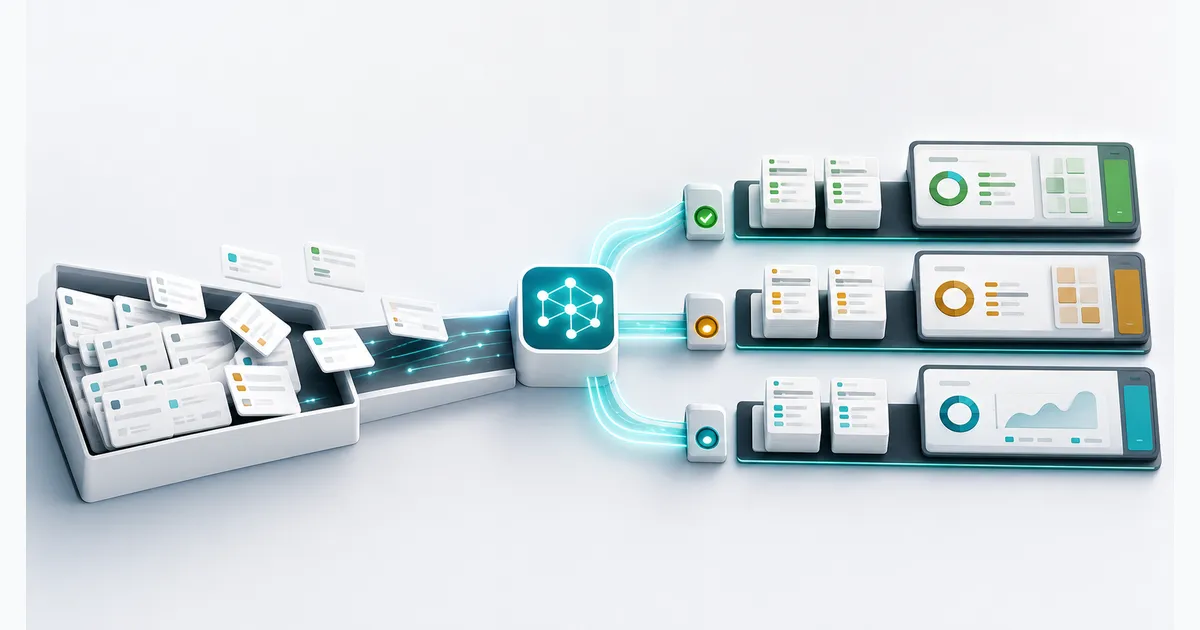
TakeawayA queue turns AI from a conversation into an operating rhythm.
A small queue system
This is the second piece in a series on building agents for company work. The first piece covered how to choose the first workflow. Once that workflow is chosen, the next question is where the work waits. Find the queue, and the agent design gets much clearer.
A Queue Is Work Waiting for a Next Step
A queue is any place where work collects before the next step happens.
Sometimes it is obvious: an inbox, a ticket board, a CRM list, an approval table. Sometimes it is hidden: a spreadsheet someone checks every Friday, a Slack channel where requests pile up, a folder of PDFs, or a mental list carried by the person everyone interrupts.
Queues are valuable because they already contain the shape of the work. They show the trigger, the volume, the owner, the common cases, the weird cases, and the places where delays or mistakes create cost.
A queue gives you the starting point. Readiness, value, risk, and ownership decide whether it becomes the first build.
The Queue Makes the Agent Concrete
A vague agent request sounds like this: we want AI to help with operations.
A queue-based request sounds like this: every morning, 40 customer emails arrive with missing order details, refund questions, and shipping exceptions. We want AI to sort them, gather context, draft the easy replies, and route the sensitive ones to the support lead.
The second version is buildable. It has inputs, categories, tools, a human owner, and a clear first version.
- Starts with a capability
- Scope keeps expanding
- Success is judged by the demo
- Exceptions appear late
- Daily operating home stays undefined
- Starts with waiting work
- Scope is tied to one backlog
- Success is judged by throughput and quality
- Exceptions get their own route
- The work has a daily operating home
What an Agent Queue Contains
A useful agent queue has more structure than a list of tasks. It describes how work enters, how work is prioritized, what context is available, which actions are allowed, when review is required, and how outcomes feed the next run.
Intake: where new work appears, such as email, forms, tickets, spreadsheets, documents, or system events.
Priority: which items matter first, based on age, customer value, risk, deadline, downstream blocker, or owner preference.
Context: the documents, history, policies, customer records, prior decisions, or source data needed to act responsibly.
Allowed action: the next step the agent can take, such as classify, summarize, extract, draft, enrich, compare, check, or route.
Review path: the condition that sends work to a person, including missing data, high dollar value, customer impact, policy exception, or low confidence.
Run record: the log of what the agent saw, what it did, which tool it used, who reviewed it, and what happened after.
This is why queues are such a useful design tool. They anchor the design in the operating rules of the work.
The Agent Owns One Step at a Time
The strongest first queue agents usually own one bounded step.
They classify a request. They extract the important fields. They research a lead. They draft a reply. They compare a document to a policy. They prepare an approval packet. They summarize a pile of updates into a status report.
That sounds modest, and modest is good. One clean step inside a real queue can remove hours of work while keeping the business comfortable. Once that step is trusted, the system can take on the next step.
- Agent handles the full process immediately
- Writes and approvals are mixed together
- Humans inspect only the final output
- Failures are hard to trace
- Trust has to arrive all at once
- Agent owns one repeatable move
- Sensitive actions stay gated
- Review happens inside the workflow
- Failures become visible cases
- Trust grows from operating history
TakeawayThe first agent earns trust by making the next pass through the queue faster, clearer, and easier to review.
Humans Stay Where Judgment Matters
A queue-based agent makes human review easier to place. The system can separate routine work from judgment work before anything consequential happens.
For example, an invoice queue can let the agent extract fields, match vendors, check for missing purchase orders, and draft an approval packet. A person still approves payment. A lead queue can let the agent research the company, identify fit, and prepare a short brief. A person still decides the relationship move.
The system saves human attention for exceptions, tradeoffs, judgment, and relationship decisions.
Human-in-the-loop gets much clearer when the loop has an actual queue. Review becomes a lane in the system with visible rules and ownership.
Which Queue Should You Start With?
A good first queue has enough volume to matter, enough structure to learn from, and enough safety to run under supervision.
Then run a readiness pass: visible inputs, a named owner, a baseline metric, a bounded action, safe tool permissions, a review lane, a feedback signal, and a trace of each run. A queue can score high and still begin with mapping, measurement, or shadow mode before live use.
Look for queues where people already complain about delay, duplicate effort, missing context, or low-value triage. Then check whether the inputs are visible and whether one person owns the outcome.
What kind of backlog is sitting in the business?
The right first agent depends on the queue shape.
What I Would Build First
If a company handed me a messy backlog and asked where to use AI, I would start by building the smallest useful queue system.
- Name the queue and the owner.
- Define the item types that appear in the queue.
- Choose one bounded agent action, such as classify, extract, enrich, draft, or route.
- Add a review lane for sensitive, uncertain, or high-value items.
- Log every decision, tool call, reviewer edit, and final outcome.
- Use the first month of history to decide the second agent action.
That first system might look simple. It should. The value comes from getting real work moving, watching what happens, and improving the queue with evidence.
The Bigger Pattern
Agent queues are one piece of a larger automation pattern. First you choose the workflow. Then you find the queue. Then you give the agent one bounded job inside that queue. Then you use review and outcomes to make the next version better.
That is how AI joins the operating rhythm: work arrives, the system prepares the next step, and people review the parts that need judgment.
Start with the place where work is already waiting.
Keep Reading
Earlier in this series: how to score which workflow should get AI help first.
AI Workflow Ranking: what to automate firstRun the free AI Workflow Ranking skillHave CloudBuddy map a workflow with you
David Johnsen
Founder, CloudBuddy Solutions
Want to automate a workflow in your business?
Start with free Workflow Mapping to find your highest-value opportunity.
Request workflow mappingMore posts
Where Business Advantage Comes From in the Age of AI
AI made software cheap to produce, which means the software itself is no longer the moat. Four advantages still compound: speed of the full loop, anything anchored to the physical world, data that improves with use, and owning one narrow problem end to end.

Fable 5: The Mythos Model Just Went Public
Anthropic released Fable 5 today, a Mythos-class model anyone with an API key can use. I ran it head-to-head against Opus 4.8 and Sonnet 4.6 on launch day, from quick puzzles to a 150,000-line codebase audit. The frontier difference shows up exactly where you'd expect, and not where you wouldn't.
AI Workflow Ranking: What to Automate First
Most AI projects fail at the first decision: which workflow to build for. AI Workflow Ranking is a repeatable way to score every workflow on readiness and value, then pick the first build that actually pays off.
A Repeatable System Audit Framework for Production Software
A repeatable framework for auditing a SaaS codebase at scale. A set of audit tracks you select and adapt to your system, an invariants loop that stops regressions, and a verification cycle that makes each audit cheaper than the last. One recent application surfaced hundreds of findings and promoted 36 invariants to code-level guardrails.
AI Just Took a Leap. Access Is Becoming a New Advantage.
Anthropic released Mythos Preview to a closed group of organizations. The capability leap is real, but the access model may matter just as much. As AI shifts from an equalizer to a gated advantage, the teams that win will be the ones that can turn that capability into working systems.
Claude Code Leaked. I Looked Under the Hood.
Claude Code CLI accidentally exposed part of its codebase. I pulled the package and looked under the hood. The direction is clear: AI agents are becoming systems.
I Rebuilt My Company Site From My Phone (At the Gym)
What it actually looks like to work with remote AI agents. What worked, what didn't, and how Claude Dispatch compares to our custom AI tools.